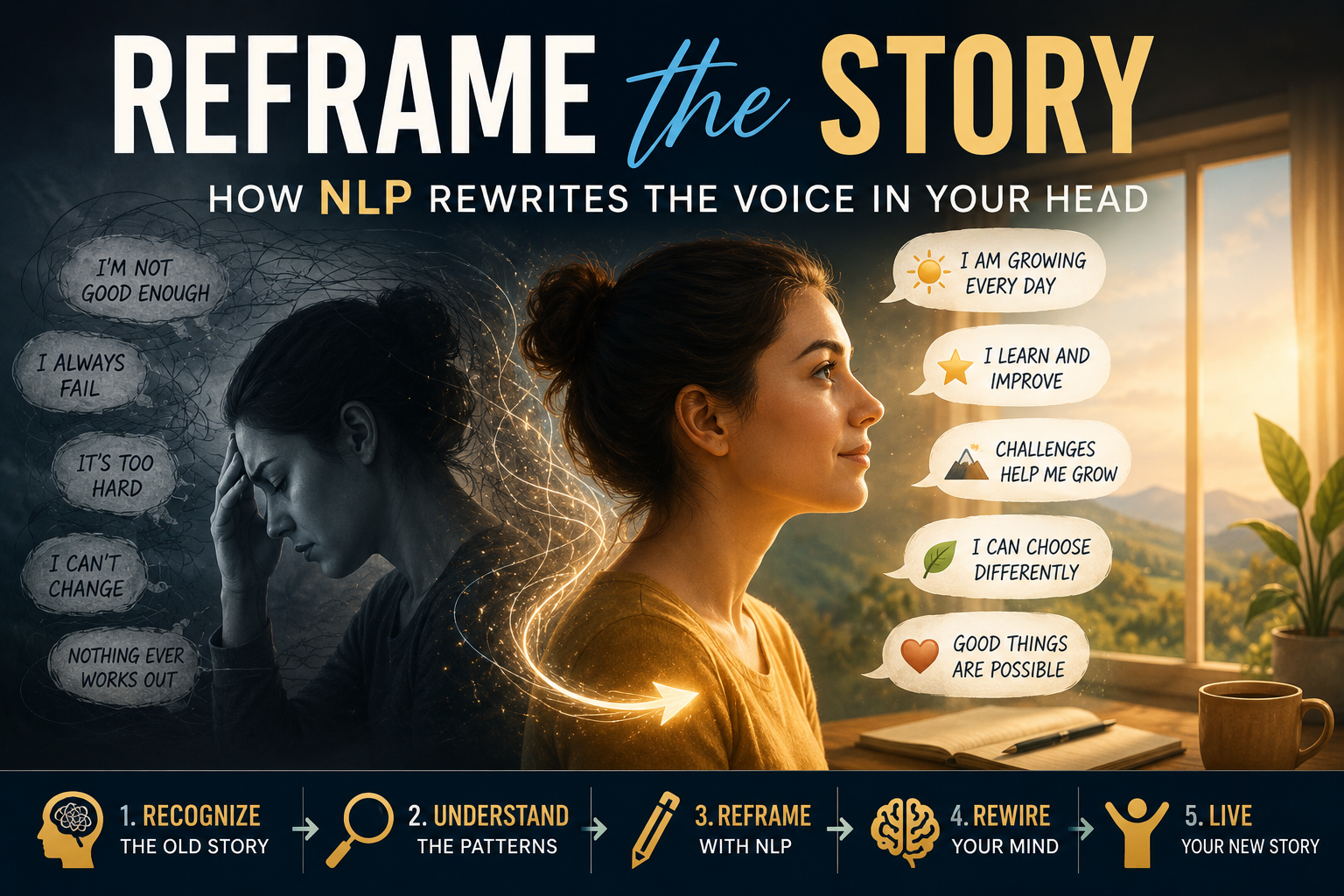
Two people lose the same deal. One says "I am not cut out for this." The other says "I just learned exactly what to fix next time." Same event. Two completely different futures.
That gap is not personality. It is a learnable NLP skill called reframing — the deliberate practice of changing the meaning of an event without distorting the facts.
Why reframing is not "positive thinking"
Positive thinking tells you to ignore reality. Reframing tells you to look harder at it. A good reframe is not "everything happens for a reason." It is "this fact is true — and here is a more useful meaning I can also assign to it."
You are not lying to yourself. You are noticing that your brain assigned the worst possible interpretation in 0.2 seconds, and asking it to consider a more accurate one.
The event is fixed. The story is software. NLP is how you patch the software.
The two reframes every coach should teach
1. Context reframe — "Where would this be useful?"
A trait you hate about yourself is almost always a misplaced strength. Ask:
- "I am too sensitive" → In what context is sensitivity an advantage? (Reading the room. Knowing when a friend is off. Catching what no one else catches.)
- "I overthink everything" → Where is deep analysis a gift? (Strategy. Editing. Risk assessment.)
- "I am too intense" → Where is intensity exactly what is needed? (Crunch time. Defending your work. Closing.)
The "flaw" doesn\'t disappear. You just stop calling it a flaw in every context.
2. Meaning reframe — "What else could this mean?"
When something happens and your brain hands you a story, pause and ask: what else, factually, could this also mean?
- They didn\'t reply. Original meaning: "They\'re ignoring me." Possible alternatives: They\'re busy. They didn\'t see it. They\'re overwhelmed. They\'re drafting a longer answer.
- You bombed the workout. Original meaning: "I\'m falling off." Alternatives: Your body needed rest. You under-ate. The plan was poorly designed.
- The client said no. Original meaning: "My offer is bad." Alternatives: Bad timing. Wrong fit. Internal budget freeze.
You are not deciding the new meaning is true. You are reminding the brain that the worst-case story it grabbed is not the only one consistent with the facts.
The 3-question reframe drill
When you notice the inner critic, run these three questions in this order:
- What did I actually observe? (Just the facts. No adjectives.)
- What story did my brain hand me? (Name it. "He thinks I\'m dumb." "I\'ll never get there.")
- What is one other story that fits the same facts? (Doesn\'t have to be cheerful — just plausible.)
Three questions. About 90 seconds. The amount of identity damage this saves over a year is enormous.
The reframe trap (and how to avoid it)
If you reframe everything immediately, you skip the data the emotion was trying to give you. Sometimes the original story is right and the action is "stop doing the thing that\'s causing this."
Rule of thumb: feel the feeling fully for 90 seconds, then reframe. The body needs to process before the mind gets curious.
What changes when you do this consistently
- Setbacks stop knocking you out for days. They knock you out for hours, then less.
- You become harder to manipulate — because someone else\'s framing of your behaviour no longer has the final word.
- You start seeing yourself in three dimensions instead of one. Same with the people around you.
Try it on one story today
Pick one recurring negative story about yourself. Write it down in one sentence. Then write three alternative meanings that also fit the same facts. You don\'t have to believe them. You just have to see them. That is the start of taking your story back.
If you want to do this work on a specific belief that has been running you, that is exactly what we do live in the next free workshop. Bring the story — leave with the reframe.