You already have anchors. The smell of your grandmother\'s kitchen. A song that yanks you back to a relationship. The ringtone that spikes your heart rate before you even look at the screen. Your brain links sensory triggers to emotional states without asking permission.
NLP just makes the process conscious. Instead of life installing random anchors for you, you install the ones you want — and you can fire them in seven seconds when you need them.
What an anchor actually is
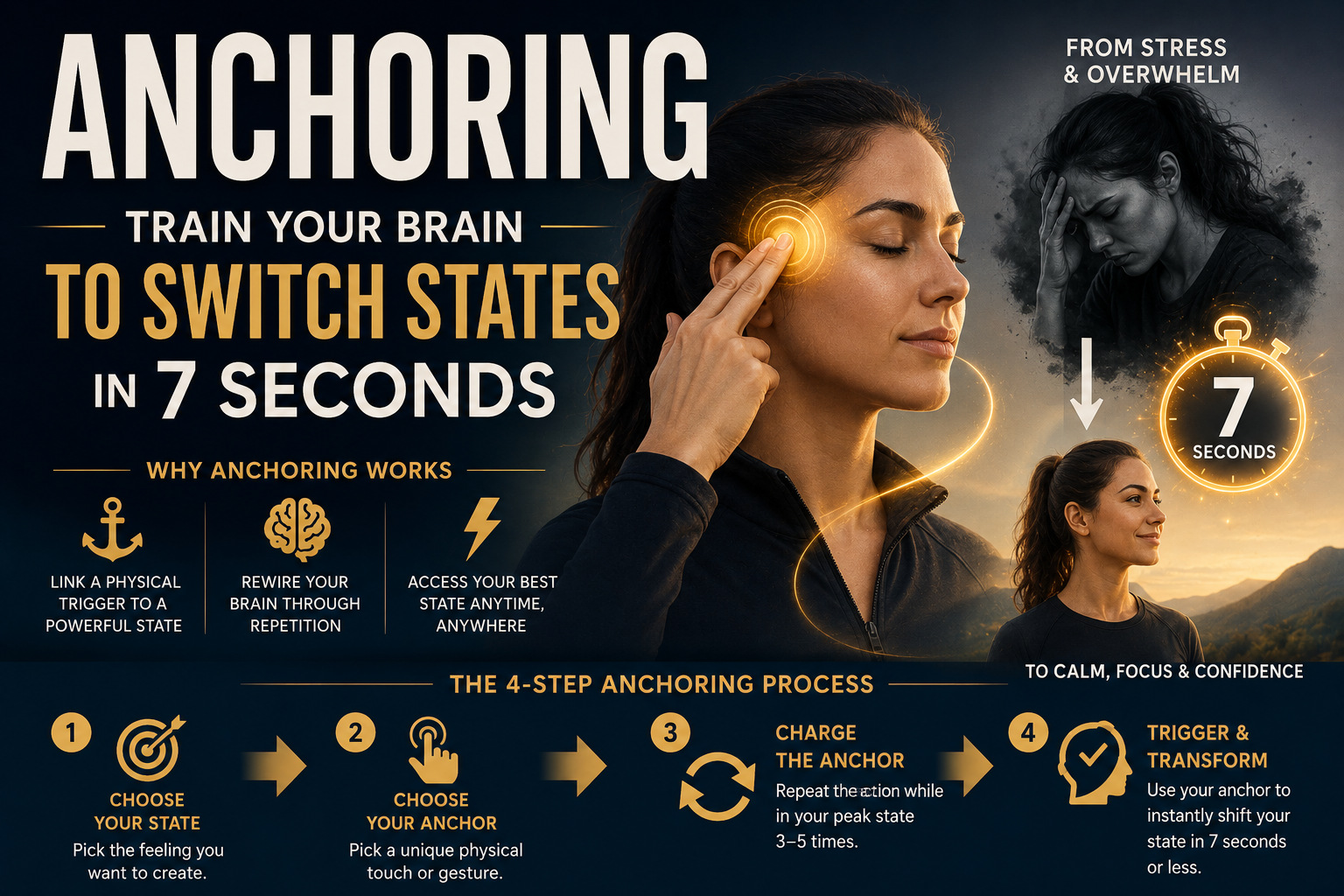
An anchor is a specific sensory trigger (a touch, a word, an image) that, after a few good reps, fires a chosen emotional state — confidence, calm, focus, courage — on demand.
It works because the brain doesn\'t store states in a vacuum. It stores them tied to whatever is happening at the moment of peak intensity. If you intentionally pair a trigger with a peak state, the trigger becomes a remote control.
The brain is not picky about why a feeling shows up. It is very picky about what was happening when it did.
How to install one in 7 seconds
Step 1 — Choose the state (1 sec)
Pick one. Not three. Confidence. Or calm. Or focus. The clearer the label, the cleaner the anchor.
Step 2 — Find the memory (2 sec)
Close your eyes and remember a specific moment you actually felt that state at full volume. Not in theory — in your body. The day you nailed the presentation. The moment after the gym. The walk after the breakthrough.
Step 3 — Step into the memory (3 sec)
See it through your own eyes again — not as a movie of yourself. Hear what you heard. Feel where the feeling lives in your body. Turn the volume up. Make the colours brighter, the sounds clearer, the body posture taller.
Step 4 — Fire the anchor at the peak (1 sec)
The moment the state hits its peak — and not before — press your thumb and middle finger together, hard, for one second. Then release.
That is one rep. Do five reps across the day. By tomorrow, the finger-press alone will start firing a noticeable slice of the state. By day 5, it will be sharp.
Three rules that decide whether it actually works
- Peak only. Anchor at the peak of the feeling, not while it is building or fading. Otherwise you anchor lukewarm.
- Unique trigger. Use a gesture you do not do casually. Thumb-and-middle-finger is good. Crossing arms is bad — you do that constantly and would dilute the link.
- Same exact way every time. Same finger, same pressure, same duration. The brain links specificity, not approximation.
Where to actually use it
- Before a difficult conversation. Fire the calm anchor in the 10 seconds before you walk in.
- Right before a workout, sales call, stage, or interview. Fire the confidence anchor.
- Mid-spiral. When you catch yourself anxious or scattered, fire the focus anchor while taking one slow breath. State change in under a minute.
What anchoring is not
It is not a magic spell. It does not replace skills, preparation, or therapy if something deeper needs care. It is a quick-access switch for states you have already proven you can access. It just makes the access reliable, not random.
Your homework
Pick one state today. Run the 4-step install in the next 10 minutes. Then fire the anchor 5 times across the rest of the day, deliberately, with the same finger-press each time. By tomorrow morning, you will have something most people don\'t — a personal state-change button.
If you want to build a stack of anchors that work together (calm → confidence → focus) join the next free workshop. We do the install live, in the room, in under 20 minutes.