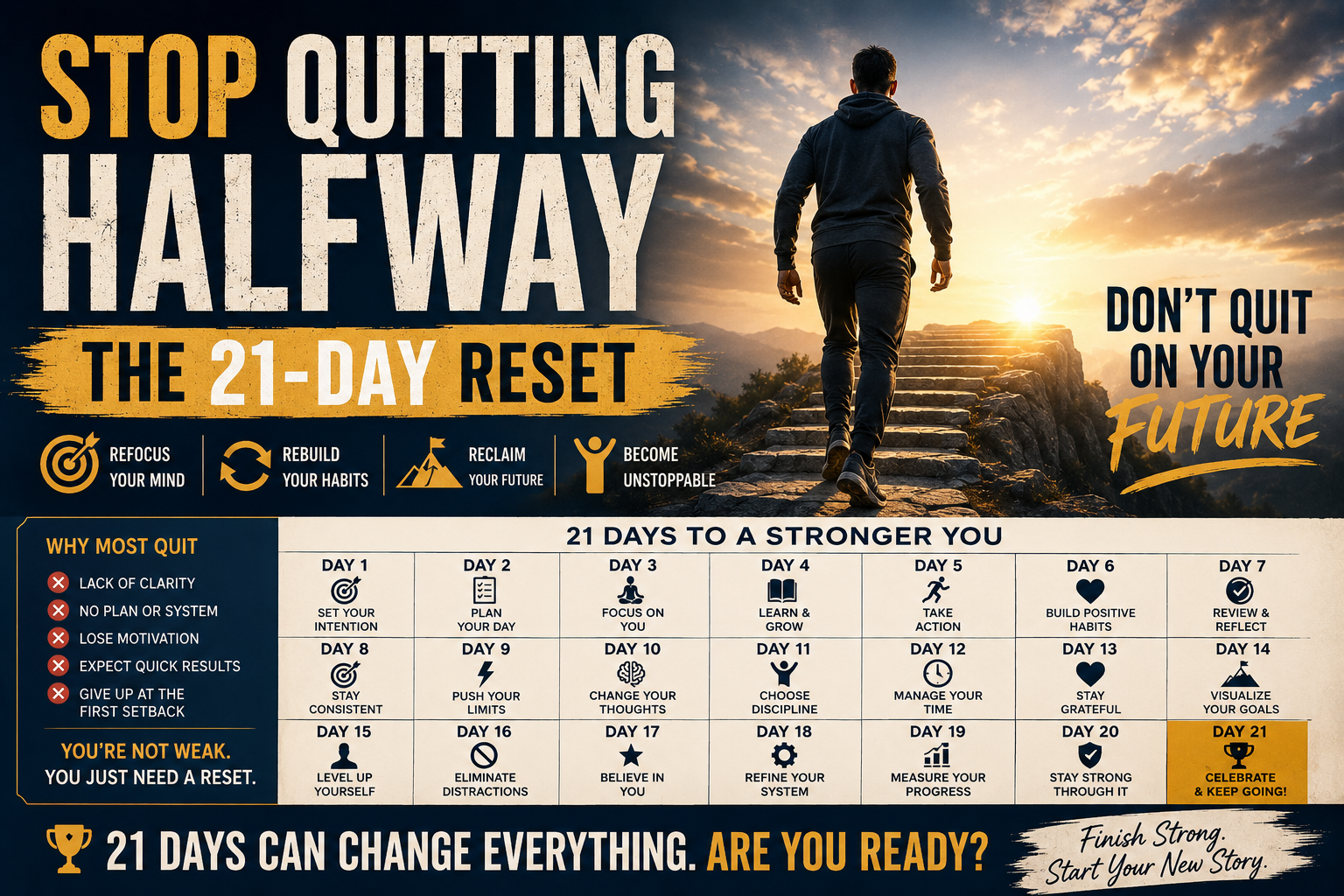
You start strong. Day 1 feels electric. By day 6 you are negotiating with yourself. By day 10 you have a "good reason" to pause. By day 12 the goal is quietly dead. Sound familiar?
The pattern is not a willpower problem. It is a design problem. Most people set up their goals like a sprint and then wonder why they collapse on day 9. The 21-Day Reset is a redesign — not a harder push.
Why people quit on day 9–12 (almost every time)
Three things stack up by the second week:
- Novelty wears off. The dopamine from "starting something new" runs out.
- Real life shows up. A late night, a sick kid, a bad mood — the original plan didn\'t account for them.
- The bar was set for your "ideal self," not your tired self. So missing one day feels like failing the whole thing.
If you don\'t plan for these three, you will quit on schedule.
You don\'t need more discipline. You need a smaller promise and a bigger recovery plan.
The 21-Day Reset, in 3 phases
Days 1–7 — Shrink the bar
Whatever your goal is, cut it to 30% for the first week. Not because you can\'t do more — but because you need to prove to your subconscious that this is a promise you keep, not a promise you break.
- Wanted to gym 1 hour/day? → 15 minutes.
- Wanted to write 1000 words? → 150 words.
- Wanted to meditate 30 min? → 5 minutes.
It will feel almost insulting. Good. That is the point.
Days 8–14 — Add the recovery rule
Here is where most people lose the game: they miss one day, then say "I already broke it" and quit. The recovery rule cancels that exit.
I am allowed to miss one day per week. The next day, I just start again. Missing two days in a row is the only failure mode.
This single sentence is the difference between people who finish 21 days and people who don\'t.
Days 15–21 — Raise the bar, gently
Now and only now, raise the daily target by 50% — never double. The point of the third week is to teach your nervous system that going harder is also safe. Not exhausting, not punishing — just slightly more.
The two questions that decide whether you finish
Every evening, before bed, answer two questions out loud:
- "Did I keep the promise today?" (yes / no — no debate)
- "What was the minimum version of this promise tomorrow?"
This is identity work disguised as planning. You are training the brain to track kept promises instead of missed peaks.
What changes by day 21
- You stop dramatising day 1 because the bar is no longer terrifying.
- You stop catastrophising day 9 because missing one day is now built in.
- You start seeing yourself as someone who finishes — and that identity, more than any technique, is what carries you to day 60, day 100, day 365.
One small caveat
The 21-Day Reset is not magic. It works because it removes the two main reasons people quit — overcommit and zero-tolerance — and replaces them with a system you can actually keep. If you keep the system, the system keeps you.
Start today, not Monday
The Monday version of you is a stranger. You can\'t outsource follow-through to a future self. Pick the promise, cut it to 30%, write the recovery rule on a sticky note, and start tonight. Day 21 will come either way — the only question is whether you arrive there as someone who finished or someone who started again.
If you want help designing a 21-day reset for your specific goal, join the next free workshop. I will help you set the bar and the recovery rule on the spot.